Any sports person or athlete would know that to compete
successfully, you must train continuously both in order to improve
fitness and to perfect skills. In sport you discover a talent, it is
nurtured as you grow up, you train, you compete, you succeed and know
that whatever happens you will be the best you can be. After
retirement it is good to keep up some level of training, both for
your physical and emotional health. It might also be that your
emotional health can be maintained by coaching the next generation.
What about those of us that have never been remotely sporty? It
seems to me that where as sports people and young musicians work with
a natural talent and train to perfect it as they mature, whereas many
of us travel in the opposite direction, at least emotionally.
Children, it seems, are born with an innate ability to be OK so that
provided they have nourishment, shelter and love, they can
emotionally flourish.
For a child, life is simple and the world of imagination and play
provide outlets for discovery, for practicing emotional skills and
the discovery of healthy emotional living. Only as we grow older do
relationships become more tricky as social pressures are placed on
us, albeit mostly well meaning, by parents, teachers and friends.
This is particularly true when we reach our teenage years. It seems
that many of our life transitions present us with emotional
challenges, whether it is leaving home, entering or leaving
relationships, becoming a parent, redundancy, retirement, children
leaving home … The list is endless.
In the same way that keeping physically fit helps to reduce the
risk of illness or helps us enjoy an active physical life, there is
growing evidence that some form of “emotional keep fit” could
help us to enjoy better emotional health, particularly through these
transitions. It could help us stave off depression or anxiety, or may
help in our relationships. A bold claim but let's think about this
for a moment.
Our first relationship is with ourselves with parental
relationships providing the prototype for each person's unique
internal model of the world. This model then goes on to determine our
ability to trust, our ability to love and to be loved, how we relate
to the world. It is what we use to construct our sense of self. If
our parents help us to create a positive sense of self, it remains
with us for life and helps us to face up to and survive the many
challenges we will face through life. This is not to say that our
emotional health depends on perfect parenting but, as Eric Burn
pointed out, with good enough parenting we create positive life
scripts and these set us on the path to an emotionally healthy path.
In reality, many of us have flawed internal models where we find
the world more scary than it sometimes should be giving rise a
general feelings of anxiety or powerlessness. Depression, for
example, is widely regarded in psychoanalytical to arise from anger
against the self and which may well have its roots in poor self
image.
In counselling, a common first objective is to create a
“reparative” relationship with the client to enable them to build
a more positive self image. In this style of relating the client is
not judged and learns not to be their own worst critic. Building a
positive relationship with ourself provides the foundation for our
relationships with others, with our loved ones, and with our
colleagues. Not everyone needs counselling and for most of us,
learning to be mindful can help us to nurture kindness towards
ourselves, more create a more positive self image and to realise just
how amazing our internal working model can be in guiding us through
the joys and perils of life.
Think of mindfulness as a kind of emotional keep fit where you
develop expert skills and being in the moment, each moment, without
judging either yourself or others, and without judging the moment. We
can learn to be mindful by using meditation to develop the skills of
the internal observer, the part of us that can see each unique moment
with wonder. However, mindfulness is not just meditation but takes
the learned skill into our everyday existence so that, for example,
you might find joy in the crunch of frost beneath you feet in the
winter, or being fully present in a conversation with a child.
In a way, it is an attempt to return to a more child-like
curiosity with the world, the curiosity that is lost as we grow older
and more cynical with the world and, worst of all, with ourselves and
our loved ones.
To learn more about counselling or mindfulness, please visit my website. http://www.innercalm.co.uk
Monday, 25 January 2016


Monday, 14 December 2015
A New Year, A New More Mindful You?
As we look to begin a new year, it is
common for us to take stock, to reflect on our achievements during
the year just past and to start to plan for the new year. You may
have decided that you need to take more exercise, to lose a little
weight, or to train for a better job, but how many of us consider the
possibility of actively improving our emotional fitness. If you have
been becoming more stressed, or if your relationships are not as
harmonious as you would like, or if you are burdened with low
self-esteem or doubts that are holding you back.
These are often symptoms that you have
an internalised self-critic at work and signs that you need to take
care of your emotional wellbeing and develop a more compassionate
self. Self compassion is the very opposite of self pity in that it
encourages you to develop a caring but wiser approach to managing
difficult emotions so that rather than using self-sabotaging
behaviours such as overeating to cope you take an active but kind
interest in your own emotional wellbeing. You can improve your
fitness through exercise and diet, you can improve your intellect
through education and skills training but to improve your emotional
wellbeing you need something quite different. That something may well
be mindfulness training.
In February, we are holding our next
Stress Management And Relaxation Techniques (SMART) programme at the
Norwich Wellbeing Centre, a 6 week course that teaches you to create
a more positive relationship with yourself. Using mindfulness,
meditation and visualisation it connects your emotional wellbeing
with your real-world existence where family and work responsibilities
and pressures are ever present. You will learn how anxiety is just as
much a physical as an emotional condition and how to create a more
harmonious mind-body connection. You will explore your own
relationship with anxiety and how anxiety can represent a low-level
nagging fear, or sometimes terror, which can sometimes give rise to
outbursts of anger.
You will learn how to treat yourself
with compassion and to extend your feelings of compassion to those
you love. In this way you will learn to treat yourself more kindly
but without destructive self-pity.
The wide adoption of mindfulness for
emotional wellbeing stems from the power that mindfulness has in
teaching us to live in the present; to learn to adopt “being mode”
rather than “doing mode”. In western culture we tend to default
to living in doing mode in which we are consumed by the need to plan,
to achieve and to acquire. Often this leads a disconnect in what we
become in order to live and what we would like to be which in turn
leads to emotional distress and the symptoms of stress.
Mindfulness teaches us to enter being
mode in which we live in the present. This does not suggest shrinking
away from responsibilities or ambition but teaches us to enjoy this
moment, which makes us more effective and can help us achieve while
at the same time enjoying this moment and this task.
We learn to be mindful by using breathing, meditation and
visualisation, but this is only the start. Can we be mindful in a
meeting or when with the family? Can we present in this moment time
and in this place with these people? Can we look on ourselves and
others with compassion?
For more information about the Stress
Management And Relaxation course, please visits www.innercalm.co.uk.
The course is limited to a maximum of 12 people. The normal cost of
the course is £180 but there is a £30 discount for places booked by
the 8th January and a further £30 discount for liking the
the Inner Calm Facebook page. At £120, perhaps a place on the course would make
a fantastic Christmas gift.
Sunday, 13 September 2015
Stress Management And Relaxation Techniques Course Coming to Norwich

Over the course of the last year or so
I have been focusing on writing and preparing a wellbeing course
based on mindfulness concepts. Mindfulness is recognised by NICE as
an affective treatment for depression and anxiety and it is widely
used along with CBT by the NHS Wellbeing Service who also
offer mindfulness-based wellbeing classes. However, the group sizes
tend to be large and the focus tends to be on problems rather than
exploring solutions, limited to meditation rather than on self-exploration and
self-development. The goals I set myself in creating the course,
therefore, were to teach mindfulness in a way that would connect with
real people in the real world, that would encourage self-development, and
to teach only to small groups where each individual would receive an adequate level of attention.
Developing the programme needed
extensive research and I also took the time to take in a wellbeing trainer
training course with the SMART Foundation (http://smartfoundations.co.uk) to develop the skills
needed to teach the course. In October, I present a six-week wellbeing
course with the title Stress Management And Relaxation Techniques
(SMART).
I couldn't help but to be struck by this
use of the SMART acronym which I am more familiar with as a
self-improvement tool from the business sector and felt less than
comfortable about using it in the title of a wellbeing course. But, the more I
thought about what I had set out to create in the course, the more
SMART made sense as a way to help professionals connect with mindfulness.
Specific
The Specific goal aims to create a better
sense of wellbeing in the attendees and teach them ways to reduce and
cope with Stress, to Manage the Stress. Along with stress and anxiety
individuals will often experience depression which reduces
effectiveness at work and undermines relationships. Mindfulness
teaches us how to actively regulate our physical hormonal states and so manage our emotions.
Measurable
The Measurable goal enables the
attendees to notice over time reduced symptoms of Stress. Perhaps
they might sleep better, find less need for alcohol, and enjoy more
harmonious relationships with friends, colleagues and loved ones.
They might even experience clearer thinking which will become obvious
as life goals feel easier to achieve.
Achievable
The Achievable goal is addressed in
that the course focuses on an honest self exploration of who we wish
to believe we are versus what the world perceives us to be. This can
be very challenging but by taking a little time out, by exploring and
developing our personal “brand” we bring these two viewpoints
closer together.
Relevant
The goal of being Relevant is met by
relating the programme to the real-world experience of each
individual. The title of Jon Kabat-Zin's book sums this up perfectly.
“Wherever We Go, There We Are”. Withdrawing from relationships or
work does not make anxiety and stress go away as it will always follow us.
So, the course does not advocate withdrawing from the world or
relationships but encourages finding ways to move towards them by
escaping the habitual negative messages we send to ourselves or
receive from others. By learning to look upon yourself and others with compassion
you learn to take responsibility for your own emotions and let those
that need to take responsibility for theirs.
Time-bound
The goal of being Time-bound is met by staging the course over 6 weeks during which attendees will take away
exercises in meditation and visualisation, develop the ability to be
in the present moment, and will develop a personal "brand" which will
remain with them always.
About the Course
The course commences at 6:30 on Friday
23rd October for 6 weeks at the Norwich Wellbeing Centre.
Yes, on Friday! But this enables attendees to find some time over the
weekend to consolidate their learning. It helps to have an open mind
when attending the course but I choose not to ignore those who are
more sceptical? What I wanted to create was something that addressed
real-world problems for those that work hard, have responsibilities
that cannot be ignored, or those who want to find ways to cope with
the pressures of life.
For more information about the Stress
Management And Relaxation Techniques course, please visits www.innercalm.co.uk.
The course is limited to a maximum of 12 people and there is a
substantial discount for early booking.
Monday, 17 September 2012
Mindfulness in Counselling
Mindfulness is becoming increasingly important as a tool in counselling and features as a central feature of Mindful CBT, but what is mindfulness and how does it help in counselling. This article hopefully provides some answers.
Mindfulness stems
from ancient Buddha practice and has profound relevance for our
present-day lives. This relevance has nothing to do with Buddha per
se or with becoming a Buddhist, but has everything to do with waking
up to and living with harmony with the world. It has to do with
examining who we are, with questioning our view of the world and our
place in it, and cultivating some appreciation for the fullness of
each moment we are alive. Most of all, it has to do with being in
touch. (Kabat-Zinn, 2004)
The value of incorporating mindfulness into
our lives is that it has the potential to teach us be aware, in the
moment, of our thoughts and sensations without judgement. There are considered to be two main modes
of mind:
- Doing modeA goal-oriented state. Often gives rises to a sense of discrepancy between how things are versus how the mind wishes things to be. If the mind continuously dwells on discrepancies, then negative feelings and emotions arise leading to habitual patterns of the mind designed to close that gap.
- Being ModeNot focused on achieving specific goals but, instead, on accepting what is without any immediate pressure to change. The mind processes from moment to moment, enabling the person to be completely engaged in the present.
In doing mode, goals
are used to ensure good or bad feelings continue, whereas in being
mode thoughts and feelings are viewed simply as events that
arise in the mind, become objects of awareness, and then are allowed
to pass from the mind.
Although meditation and guided
visualization are examples mindfulness practice (Kabat-Zinn, 2001), mindfulness is not by definition meditation and this is
an important insight for those whom meditation is a new experience
(Wellings & McCormick, 2000). One seemingly unlikely example of mindful
functioning I like to use is that of Formula 1 racing drivers who are
able to observe and respond to events, bodily sensation and their existence in their environment with microsecond resolution by being mindfully present in
the the process. Paradoxically, while the aim of the driver is to be
first over the finish line to be greeted by the chequered flag, he
can only do this by experiencing at the deepest level every turn,
straight line and pit stop and being mindfully present in every millisecond.
Mindfulness and counselling
The skills we seek to promote in counselling are
intended to avoid rumination about events and feelings that would
tend to reinforce depression or anxiety. Instead, we seek to create
a curiosity and awareness of the processes and how we experience
them, allowing the client to focus less on reacting to stimuli and
more on accepting and observing them without judgment.
A key feature of
mindfulness is that it changes our relationship with our internal
experiences. Although anxiety prompts us to turn away from
uncomfortable or painful experiences, mindfulness allows us to
approach them. Rather than judging some internal experiences to be
acceptable and others to be unacceptable or loathsome, mindfulness
involves bringing curiosity and compassion to all or our experiences.
(Susan M Orsillo, 2011).
Again, paradoxically, by not being focussed
on the outcome of forcing changes to behaviour, mindfulness
encourages us to observe without judgement changes that occur through the practice mindfulness. In this way it is a powerful aid to
developing the self-observer who is able to fully participate in, for
example, the development of a formulation rather than to be the
recipient of an expert diagnosis.
Using mindfulness with clients
My inclination in using mindfulness with any client is introduce it at a cognitive level. In this way is linked with the autonomic arousal model that illustrates how mental states and physical states are intimately linked. Of particular interest is the effect of raised levels of cortisol in the brain (Gerhardt, 2004) and in maintaining depression or anxiety (Greenfield, 2002). To counter this I enjoy sharing with clients the concept of mental strawberries which promote endorphins (Bloom, 2001) through being mindfully present during all moments in life.
One client who benefitted from this
approach was a young woman who
suffered with depression and low self esteem. Over a number of
sessions we worked with a graphical representation of her significant
relationships in which she used symbols to represent significant
others. She elaborate symbols for her mother, father, and siblings and her husband. She depicted herself as a plain unadorned letter D.
We worked a visualization for
which we developed the image of a large shallow and rock strewn
Canadian stream with sun glinting off the surface rapidly flowing
water, “Like diamonds”. This was the symbol she chose to adopt to
represent herself. The effect of this was to allow her to observe herself with much more kindness than before and free herself from a overwhelmingly powerful inner critic.
Tuesday, 28 August 2012
CBT is Not the Only Talking Therapy: A point of view
It's tough finding a counsellor that suits every individual and any one counsellor will not suit every client. Also, the increasing medicalisation of mild to moderate mental distress does not always help the individual to get better. This is why properly qualified independent counsellors need to be allowed to offer a range of alternatives.
Wide spread ignorance in general practise leads to the belief that CBT is the only model of talking therapy that works and that it must be administered only by the NHS. As powerful as CBT is, the widespread dismissal of psychoanalytic theory by many of its practitioners means that it does not always provide lasting relief from emotional distress, especially with the strict rationing number of sessions allowed. It is effective for rapid symptom relief and does work over the long term for many, but not all. The medical model of "treatment" means that the client is seen as a "patient" with a set of "symptoms", and the client is reduced to a set of problems and any failure in the client to improve can be seen as a failure in the commitment of the client.
It is interesting that in many areas of the country that those providing treatment for mental illness under the IAPT (Improved Access to Psychological Therapies) schemes specifically exclude those with training in counselling in favour of those more accepting of a strict medical model. They also make high demands on their practitioners in terms of numbers of clients they must see. This can often result as the patient being seen in terms of outcomes that favour, or not, the practitioner and the genuine relationship between them becomes strained.
By contrast, integrative counselling is founded on the intersubjective relationship between the client and counsellor and offers a talking therapy that truly respects the individuality of the client. It provides an holistic approach to counselling that embracing humanistic, psychoanalytical, and cognitive psychological theories and encourages a detailed exploration of phenomena and from this exploration the meaning underlying a client's distress. Any development of negative regard by the client of the counsellor are seen as just one phenomenon which can usefully be explored to reveal the underlying meaning and how this meaning is played out in the present, often to the detriment of the client's relationships.
There are many well regarded colleges and institutions that offer well-founded training to degree level and beyond, ensuring that their graduates are fit to practise as counsellors and psychotherapists. With advent of the voluntary regulation by the Professional Standards Authority (PSA) for Health and Social Care, GPs and potential clients can have confidence that those included in the approved registers of accredited counsellors maintained by the BACP, UKCP and other ethical bodies have proper training and experience and are subject to a complaints procedure designed to protect the client.
CBT has many virtues and is a model I use in my own practise when requested, but it is not the only talking therapy. Let's please keep it that way.
Wide spread ignorance in general practise leads to the belief that CBT is the only model of talking therapy that works and that it must be administered only by the NHS. As powerful as CBT is, the widespread dismissal of psychoanalytic theory by many of its practitioners means that it does not always provide lasting relief from emotional distress, especially with the strict rationing number of sessions allowed. It is effective for rapid symptom relief and does work over the long term for many, but not all. The medical model of "treatment" means that the client is seen as a "patient" with a set of "symptoms", and the client is reduced to a set of problems and any failure in the client to improve can be seen as a failure in the commitment of the client.
It is interesting that in many areas of the country that those providing treatment for mental illness under the IAPT (Improved Access to Psychological Therapies) schemes specifically exclude those with training in counselling in favour of those more accepting of a strict medical model. They also make high demands on their practitioners in terms of numbers of clients they must see. This can often result as the patient being seen in terms of outcomes that favour, or not, the practitioner and the genuine relationship between them becomes strained.
By contrast, integrative counselling is founded on the intersubjective relationship between the client and counsellor and offers a talking therapy that truly respects the individuality of the client. It provides an holistic approach to counselling that embracing humanistic, psychoanalytical, and cognitive psychological theories and encourages a detailed exploration of phenomena and from this exploration the meaning underlying a client's distress. Any development of negative regard by the client of the counsellor are seen as just one phenomenon which can usefully be explored to reveal the underlying meaning and how this meaning is played out in the present, often to the detriment of the client's relationships.
There are many well regarded colleges and institutions that offer well-founded training to degree level and beyond, ensuring that their graduates are fit to practise as counsellors and psychotherapists. With advent of the voluntary regulation by the Professional Standards Authority (PSA) for Health and Social Care, GPs and potential clients can have confidence that those included in the approved registers of accredited counsellors maintained by the BACP, UKCP and other ethical bodies have proper training and experience and are subject to a complaints procedure designed to protect the client.
CBT has many virtues and is a model I use in my own practise when requested, but it is not the only talking therapy. Let's please keep it that way.
Monday, 13 August 2012
Listening is hearing, right?
During a counselling session a while ago, a young female client looked at me with a quizzical look and said, "I told my boyfriend that you wear hearing aids and yet you seem to be the only person ever to have heard me!"
It seems to me that this illustrates perfectly the difference between hearing and listening. Having severe hearing loss in both ears, I need some pretty expensive technology to help me hear clearly which, thanks to our dear old NHS, I have. But that's only half of it. In order to "hear the other" I have to "listen", to give that person my undivided attention and to switch off the noises of prejudice and preconception in my own head.
Paradoxically, in counselling, listening actually involves some speaking. Not in an uncontrolled way and not with the intention of imposing your own thoughts or seeking those moments of gratification that you get when chatting with friends, but to explore the thoughts, ideas and fears of your client. The mutual, intersubjective understanding that arises from this is the bedrock of the counselling relationship in which trust and attunement develop allowing the client to feel heard. This, then, allows the client to feel safe enough to explore the roots of their unhappiness. Over time, this act of listening is experienced as therapeutic and allows the client to heal.
What I have learned from this is that listening is really an act of loving kindness and that when talking to friends and family if you take the time to listen, you may hear so much more and may even find it deepens your relationships.
It seems to me that this illustrates perfectly the difference between hearing and listening. Having severe hearing loss in both ears, I need some pretty expensive technology to help me hear clearly which, thanks to our dear old NHS, I have. But that's only half of it. In order to "hear the other" I have to "listen", to give that person my undivided attention and to switch off the noises of prejudice and preconception in my own head.
Paradoxically, in counselling, listening actually involves some speaking. Not in an uncontrolled way and not with the intention of imposing your own thoughts or seeking those moments of gratification that you get when chatting with friends, but to explore the thoughts, ideas and fears of your client. The mutual, intersubjective understanding that arises from this is the bedrock of the counselling relationship in which trust and attunement develop allowing the client to feel heard. This, then, allows the client to feel safe enough to explore the roots of their unhappiness. Over time, this act of listening is experienced as therapeutic and allows the client to heal.
What I have learned from this is that listening is really an act of loving kindness and that when talking to friends and family if you take the time to listen, you may hear so much more and may even find it deepens your relationships.
Thursday, 12 April 2012
The Growing Pains of Private Practice
It is widely accepted among counsellors that it is rare to make a living from private counselling practice. When you consider the sheer cost of qualifying, it makes you wonder why any of us would bother. What does it say about those that would propose to help cure the emotional ills of others and help them live more happily? Why go to all this trouble and expense?
In addition to the course tuition fees, books and so on, there is the requirement to undertake personal therapy, to pay for clinical supervision while in placement. At the end you come out with a degree and title to put on your business card. If I am honest obtaining a degree appealed to my ego and was a huge incentive for undertaking the course but so was the notion of being able to do something worthy. Following qualification, then the next steps were to become a member of the BACP and registered with the UKCP.
Now what? Having qualified, and having got the credentials, the next task was to launch a counselling practice.
Clearly, we still need more. It seems we now have to be more subtle and use social media to reach a wider audience, but even this has to be done in two characters. My personal page is only open to family and very close friends but my Inner Calm page on Facebook is starting to show encouraging signs of life.
 Now that they can find me, how do potential clients know if I am any good?
What does appear to have helped here is to make myself visible "in the flesh" which is what I tried in March at a Mind, Body and Soul festival in Norwich. This has brought a few solid enquiries and has encouraged me to rebook for November and also attend the Mind, Body and Spirit Festival at the Forum in Norwich on 27th and 28th April. There people get the chance to put a face to the brand and get to see in person what I'm about.
Let's not get carried away with the gloom here. Since I began private practice as my main occupation just over a year ago, I have not been without at least a couple of clients at a time, and my work at Off the Record Counselling Service in Norwich means that counselling is paying its way. Working with employees referred by Aviva Health Insurance has also boosted my work load and means that I may well soon reach the limits of my capacity to practice.
While at the Mind, Body and Spirit Fair, I promoted and then presented a successful mindfully-based anger management workshop and will be promoting more wellbeing workshops at the Forum. These are really enjoyable to do as you can get such a sense of involvement between those that attend. Limiting the group size to just eight is essential to this.
So, over the next year the aim will be to solidify the counselling, develop and grow the workshops and to offer my services as a wellbeing facilitator and presenter to individuals and organisations. Overall, I have enjoyed the challenge of growing Inner Calm through these incredibly tough financial times to a point where it is starting to happen. Here's to a viable and fulfilling way of working over the longer term future that is Inner Calm.
In addition to the course tuition fees, books and so on, there is the requirement to undertake personal therapy, to pay for clinical supervision while in placement. At the end you come out with a degree and title to put on your business card. If I am honest obtaining a degree appealed to my ego and was a huge incentive for undertaking the course but so was the notion of being able to do something worthy. Following qualification, then the next steps were to become a member of the BACP and registered with the UKCP.
Now what? Having qualified, and having got the credentials, the next task was to launch a counselling practice.
- Prepare a suitable room at home, find a room to rent in town, or both. Check!
- Sort out professional indemnity insurance and appropriate property insurance. Check!
- Get a listing on the Counselling Directory. Check!
- Build my own website. Check!
Clearly, we still need more. It seems we now have to be more subtle and use social media to reach a wider audience, but even this has to be done in two characters. My personal page is only open to family and very close friends but my Inner Calm page on Facebook is starting to show encouraging signs of life.
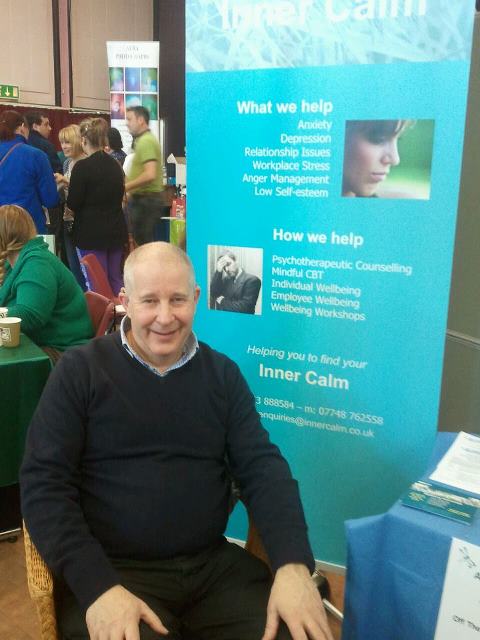
What does appear to have helped here is to make myself visible "in the flesh" which is what I tried in March at a Mind, Body and Soul festival in Norwich. This has brought a few solid enquiries and has encouraged me to rebook for November and also attend the Mind, Body and Spirit Festival at the Forum in Norwich on 27th and 28th April. There people get the chance to put a face to the brand and get to see in person what I'm about.
Let's not get carried away with the gloom here. Since I began private practice as my main occupation just over a year ago, I have not been without at least a couple of clients at a time, and my work at Off the Record Counselling Service in Norwich means that counselling is paying its way. Working with employees referred by Aviva Health Insurance has also boosted my work load and means that I may well soon reach the limits of my capacity to practice.
While at the Mind, Body and Spirit Fair, I promoted and then presented a successful mindfully-based anger management workshop and will be promoting more wellbeing workshops at the Forum. These are really enjoyable to do as you can get such a sense of involvement between those that attend. Limiting the group size to just eight is essential to this.
So, over the next year the aim will be to solidify the counselling, develop and grow the workshops and to offer my services as a wellbeing facilitator and presenter to individuals and organisations. Overall, I have enjoyed the challenge of growing Inner Calm through these incredibly tough financial times to a point where it is starting to happen. Here's to a viable and fulfilling way of working over the longer term future that is Inner Calm.
Subscribe to:
Posts (Atom)